Borusan Contemporary,
is a contemporary art, collection and education initiative of the Borusan Kocabıyık Foundation.
Personal Data Protection
Cookie Policy
© Borusan Contemporary, 2026.
Blog
Scalar Tensions
22 May 2026 Fri
The first feeling that surfaces upon seeing Edward Burtynsky’s photographs is a hesitant awe. Awe as in the sublime, in the romanticist sense, where nature’s scale exposes human insignificance within it. However, this sense of scale is not limited to what the viewer perceives in front of a single image, it operates as a structuring framework that shapes the majority of the exhibited works spanning vast geographies and diverse modes of production. This text critically examines Burtynsky’s photographic practice, which is associated with critiques of capitalism, through its use of aerial perspective and the intensified perception of scale it produces.
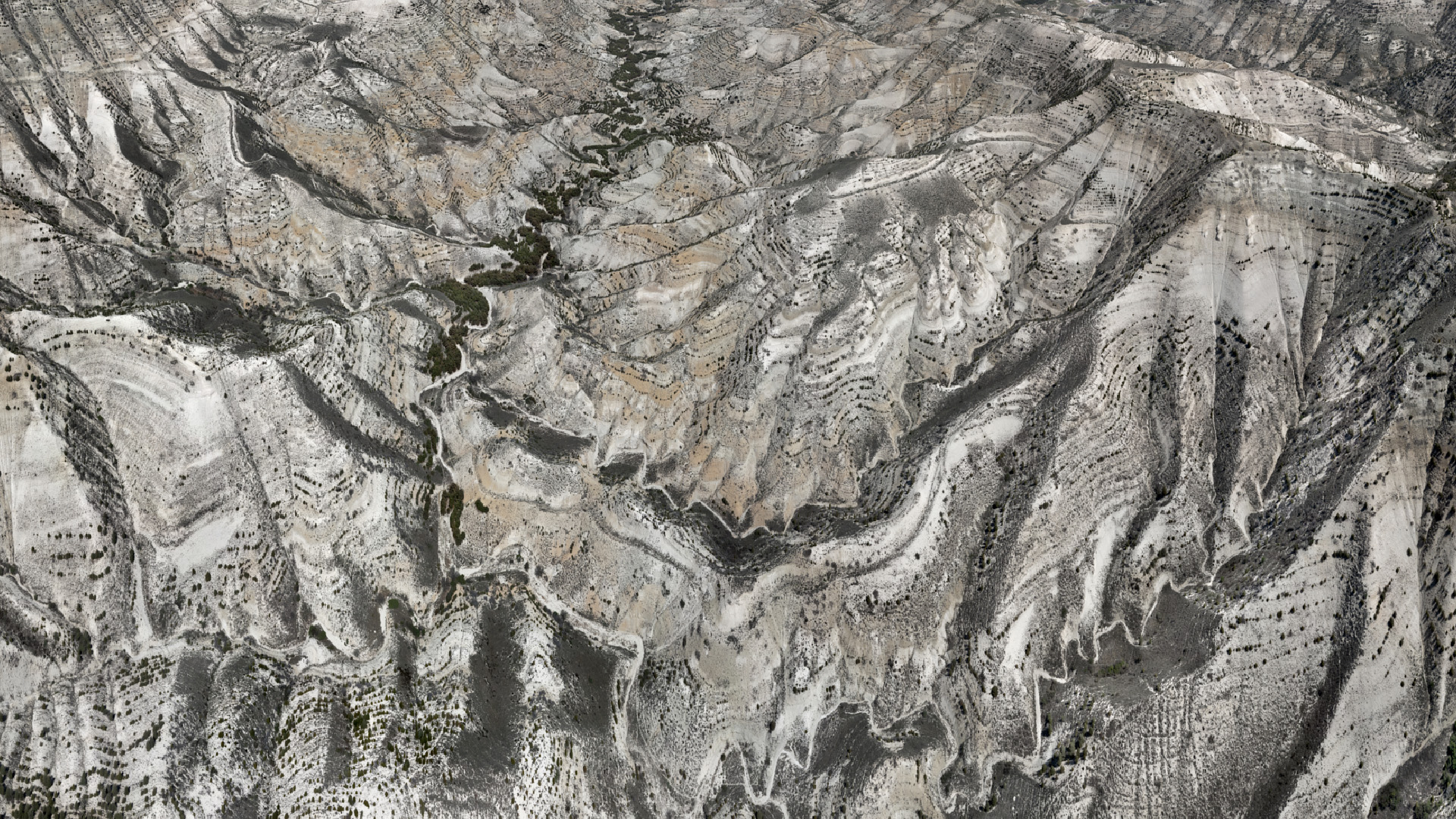
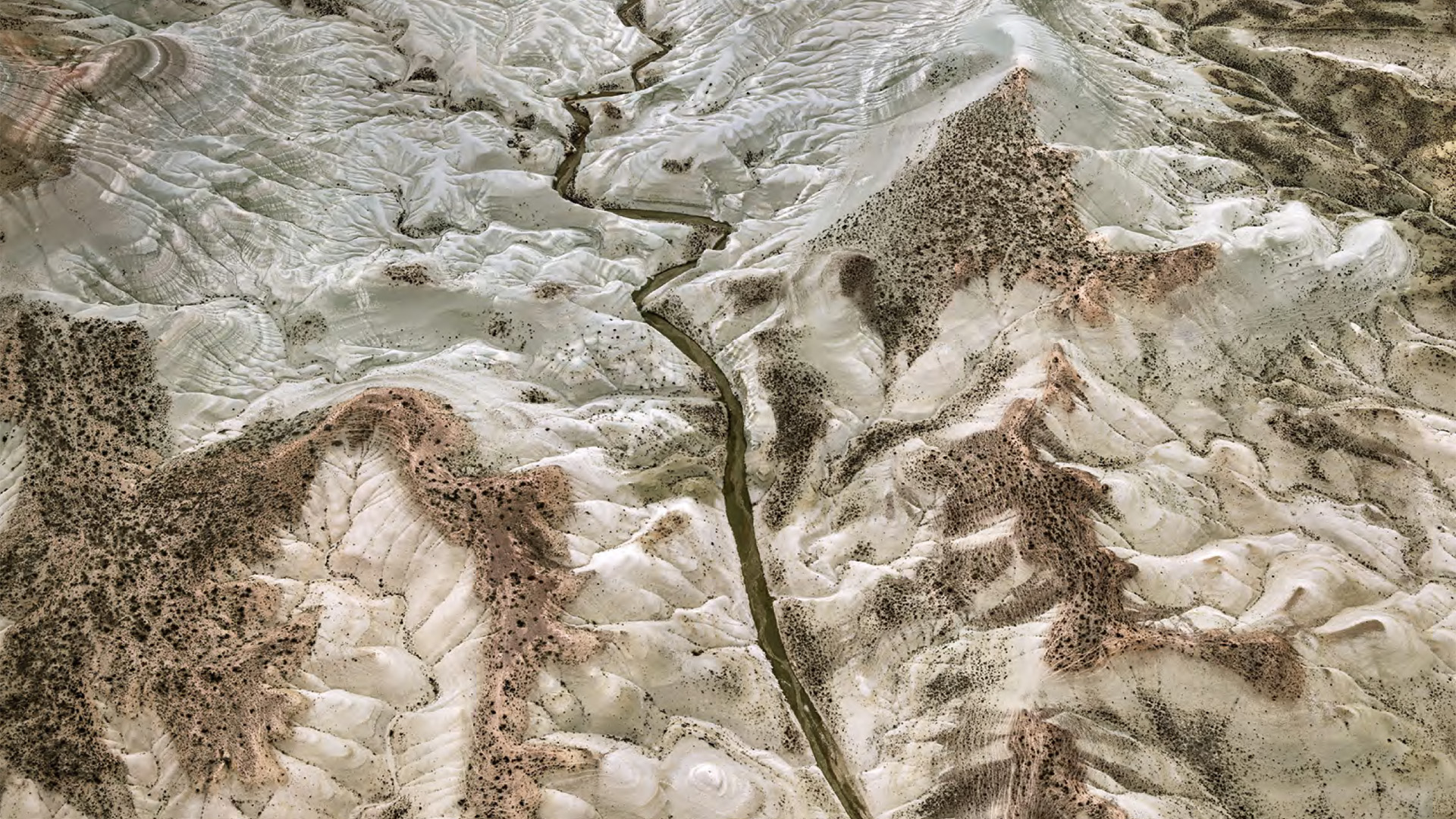
The exhibition Shifting Topography opens with the Erosion series, composed of thirty-six photographs taken across various parts of Türkiye that are affected by soil erosion that have reshaped the landscape. Following a commission from the Borusan Contemporary Art Collection, the relevant sites were identified through a research process initiated in 2019 and in 2022 the project was carried out in collaboration with local experts. The photographs were produced by Edward Burtynsky together with field producer Jim Panou, using drones and helicopters. The series is presented as a set of aerial views of landscapes shaped not only by erosion but also by various interventions designed to control soil degradation, alongside traces of antique civilizations.
The exhibition continues with Burtynsky’s other series, Water and Salt, African Studies, Nature, Quarries, Oil,and Berezniki Mines all of which document, in different ways, the influence of humans on or beneath the crust of the earth. Although they are devoid of human figures, they nonetheless register a wide range of human activity. The large-format photographs radiate technical excellence and engage the viewer by offering a vantage point otherwise inaccessible to human perception. The sense of awe oscillates between the pronounced scale of the earth and the achievements of technological progress.
A photograph from African Studies, one taken above Makoko, a floating settlement in Lagos Nigeria, disrupts my sense of awe, returning me to a memory of a township on the outskirts of Cape Town, South Africa. Parts of the township were populated by residential units composed of make shift barracks, much like those in Makoko. While Makoko has a distinct urban and economic structure, both contexts and their urban configurations remain entangled with the present-day social, political, and economic implications of colonial legacies.
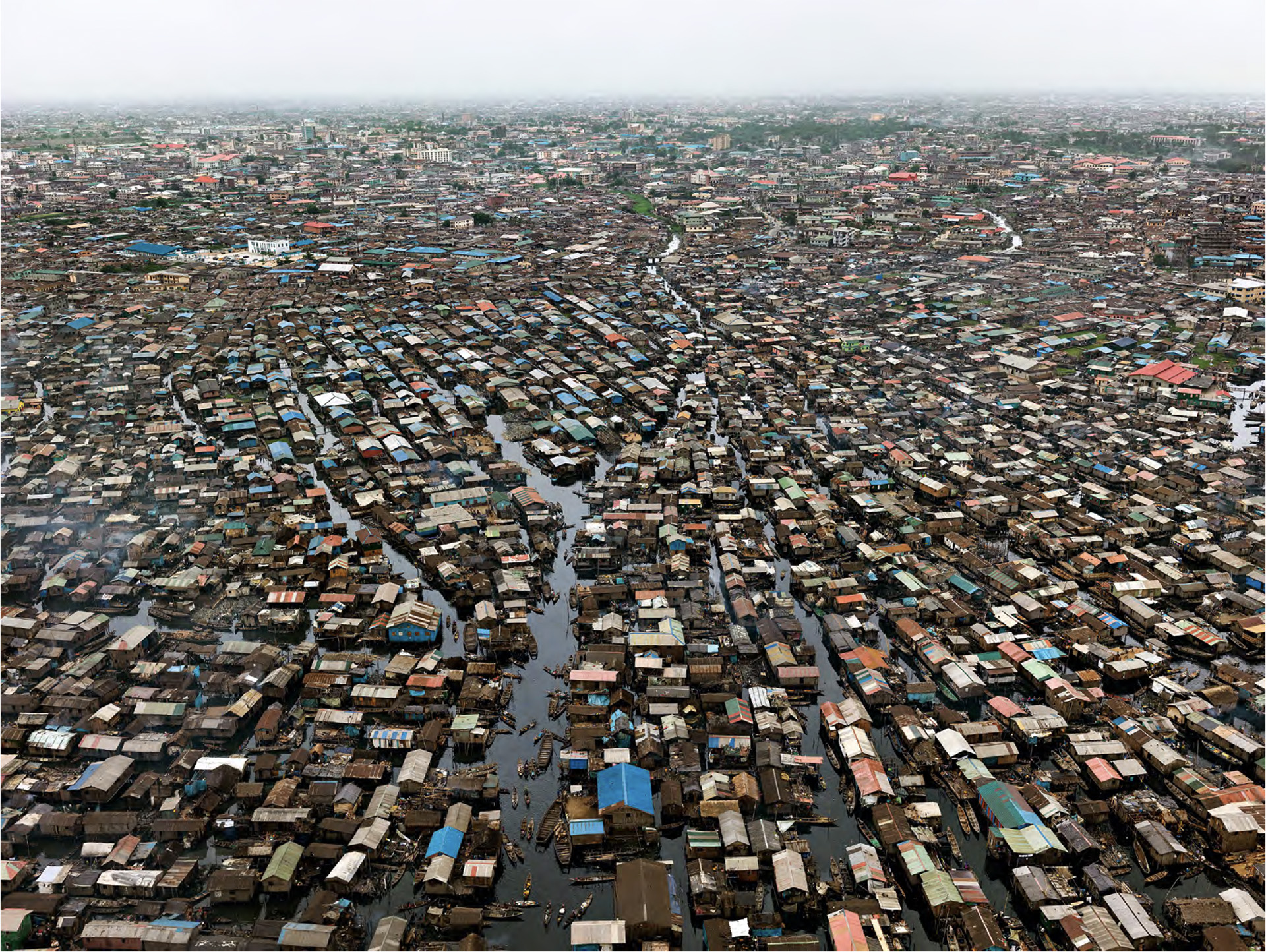
Edward Burtynsky, Makoko #1, Lagos, Nigeria, 2016
Courtesy of the artist and Flowers Gallery, London
The African Studies series (2015–19) presents a set of views that register the many forms of industrial extraction visible on the various parts of the African continent. It traces these processes from oil leaks in the Niger Delta and temporary settlements formed around the hazardous extraction of sapphires in Madagascar, to traditional salt ponds in Senegal used for mineral harvesting and the tailings of diamond, gold, and iron ore mines in South Africa. Other series extend this visual logic, presenting various modes of production and their environmental consequences, including his series on marine aquaculture in Fujian and copper mines in Arizona, as well as the series featured in the exhibition on marble quarries in Carrara, Italy, and potash mines in Russia.
The aesthetic of Burtynsky’s aforementioned series unfolds primarily through an aerial perspective. This mode of vision, materialized through maps, satellite, and drone imagery, emerges from historical infrastructures of surveillance, military operations, and colonial administration. A recent exhibition at another Istanbul institution examined aerial view from a historical and political perspective. The exhibition “Palestine from Above” held at ANAMED 1 interrogated the politics of this gaze in relation to Palestine, situating it within the context of Israel’s settler colonial oppression and ongoing genocidal campaign, while also addressing the various historical uses of imaging and mapping technologies. In this sense, aerial gaze is not a neutral viewpoint but a historically situated visual regime. The aerial view has more recently resurfaced within contemporary art as the aesthetic by-product of investigative methods. Denoted as the “forensic turn,” this shift refers to the use of spatial techniques to investigate and reconstruct various forms of violence and human rights violations for evidentiary purposes, while employing a range of technologies including those that adopt the aerial gaze among others such as GIS mapping and 3D modelling. 2
The centrality of the aerial gaze in the exhibition strengthens the scale disparity one feels. Scale constitutes the fundamental problem in Fredric Jameson’s critical framework cognitive mapping, that engages with the question of how to navigate the incomprehensible scale of late capitalism. On the aesthetic dimension, this framework brings up the question of irrepresentability of such vast interconnected and entangled systems of production, consumption, logistics, financial operations as such and sees aesthetics emerging from not subjective intention but as a response to the challenge of representing it. 3
This structural problem of scale also informs the viewer’s affective experience of the exhibition. I am inevitably reminded of the protagonist of the famous 1818 painting Wanderer above the Sea of Fog by Caspar David Friedrich. In Burtynsky’s photographs, the tension between human insignificance before vast landscapes and the relative power afforded by an all-encompassing vantage point perhaps evoke a similar sentiment shared by nineteenth-century Romantic painters. Though informed by a completely different set of material conditions, the ambivalent feelings of the Romantics are not completely unfamiliar to the contemporary individual. The painting marks a moment in Western history when confidence in Enlightenment ideals of reason and objectivity was increasingly unsettled. Although new technologies, as products of the human mind, appeared to provide a degree of mastery over newfound lands, peoples, and natural forces, they also revealed the limits of human control that exceeded human capacity. The painting’s central tension is a scalar one, embodied in the figure who both seeks to comprehend and command nature and is, at the same time, overwhelmed by its totality.
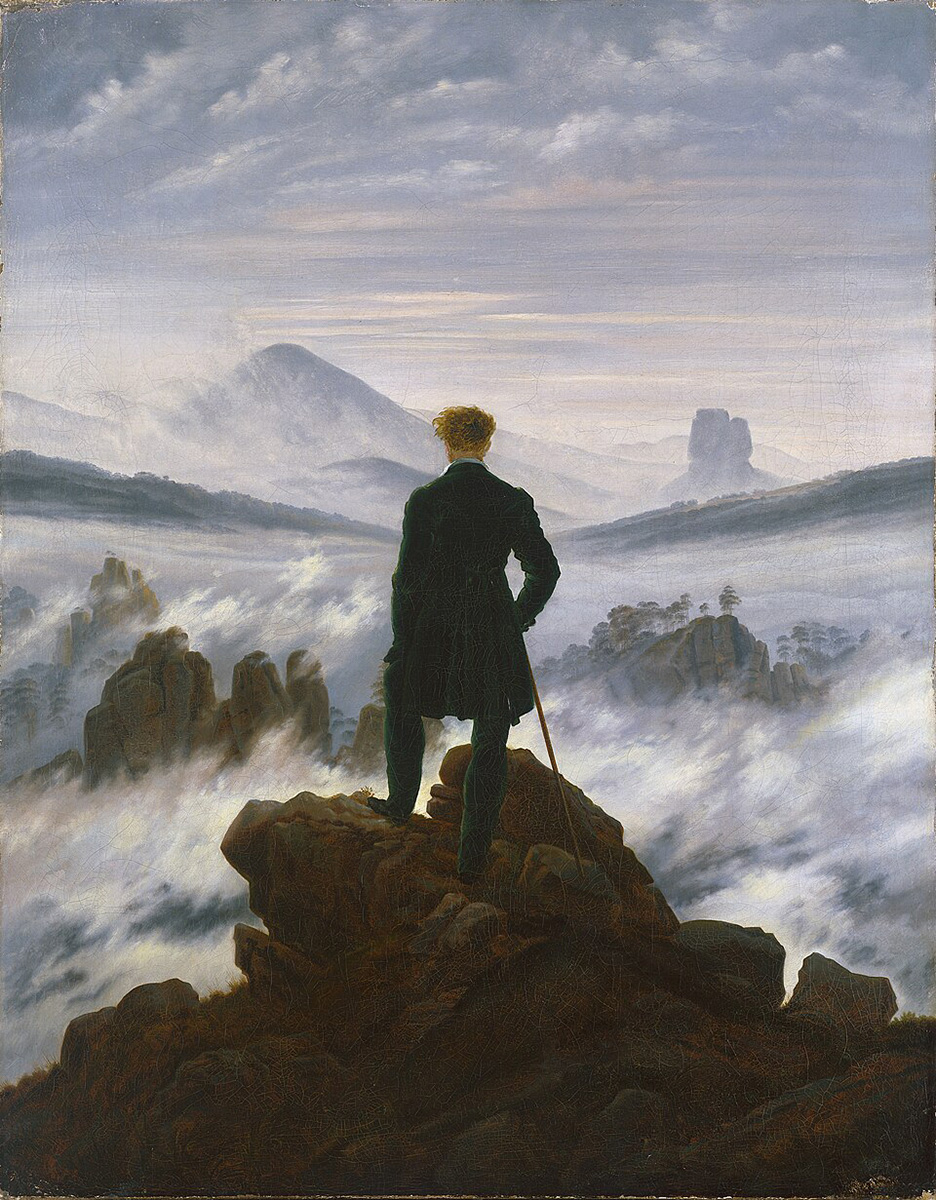
Caspar David Friedrich, Wanderer above the Sea of Fog, 1818
By mobilizing aerial perspectives to reveal the scale of capitalist operations, it is productive to consider Burtynsky’s photographs in relation to the logic of cognitive mapping. Various texts in the exhibition catalogue subtly position the exhibited works critically in relation to capitalism by foregrounding its environmental costs and labor exploitation, albeit within a de-historicized framework. For instance, the colonial legacy that underpins the very existence of this capitalist system is only briefly noted in the curatorial framing. In his book How Europe Underdeveloped Africa, Walter Rodney demonstrates how the underdevelopment of Africa and the development of Europe are structurally intertwined, still perpetuated through the capitalist structures in the present moment. 4 From this angle, the works operates within a presentist critique of capitalism rather than extending to the longer historical formations that sustain and reproduce it in the present day.
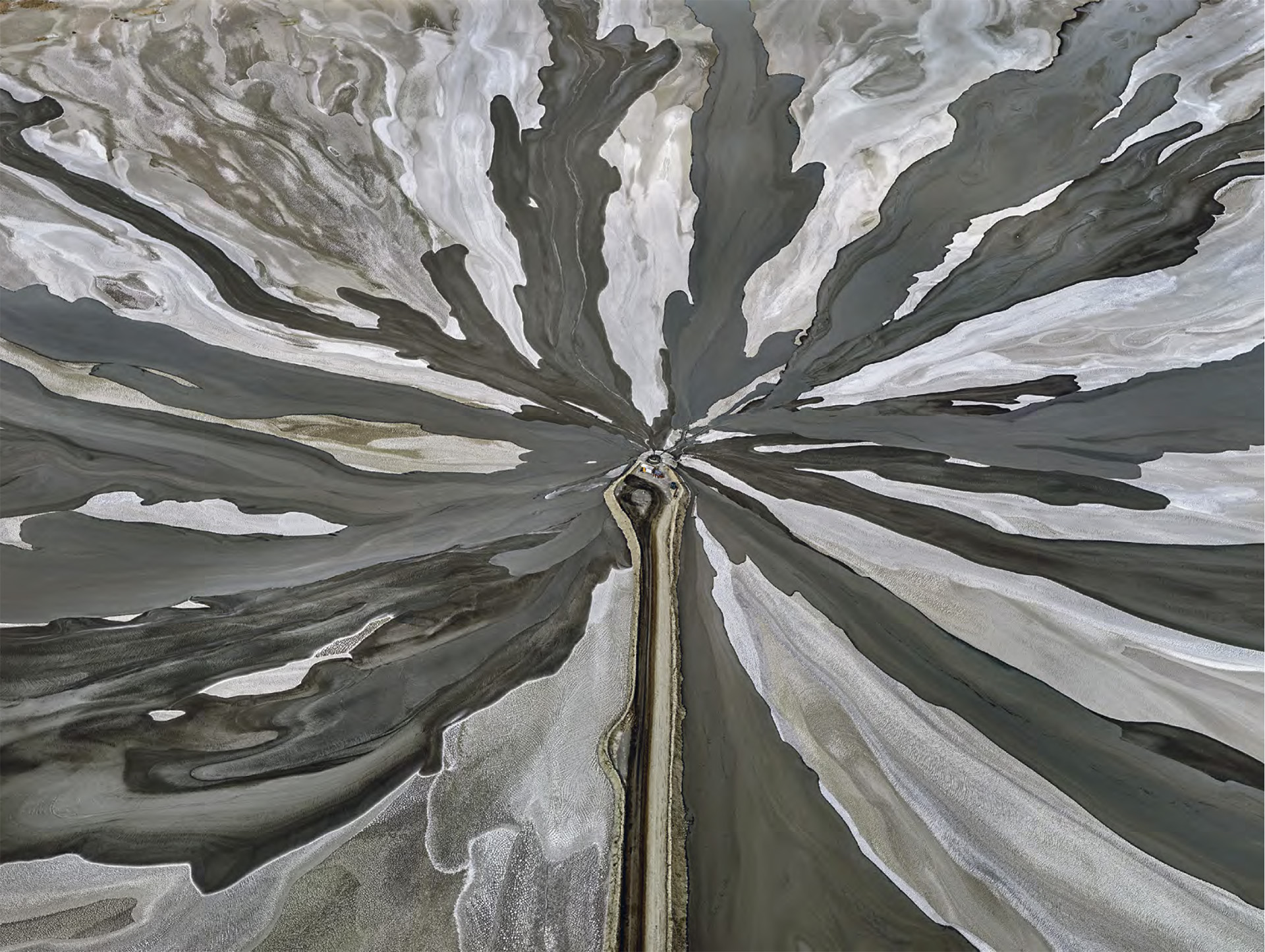
Edward Burtynsky, Tailings Pond #2, Wesselton Diamond Mine, Kimberley, Northern Cape, South Africa, 2018
Courtesy of the artist and Flowers Gallery, London
Some of the images exhibited are astounding in their capacity for abstraction, executed with a painterly sensitivity to color, gesture, and composition. In the catalogue, various connections are drawn to modernist and contemporary practices and artists such as Pointillism, Georgia O’Keeffe, and El Anatsui, thereby situating Burtynsky’s photographic images within the art historical canon. This abstraction appears as a consequence of the aerial perspective, the distance required to produce these images also leads to a distance from the historical and political conditions they depict.
Albeit working within a representational aesthetics, these images mobilize scale and aerial gaze in ways that align with the problem diagnosed by Fredric Jameson: How to render a vast and complex system exceeding human comprehension visible and perceptible? In that sense, it appears plausible to think Burtynsky’s oeuvre in relation to what these images do and how they function within the aesthetic and political conditions of late capitalism. As one stands in front of a larger than life, hyper detailed image of an environmental devastation, does one really approximate a level of comprehension? How might one move beyond these striking representations toward a deeper understanding? Or does one, like Friedrich’s wanderer, remains suspended in awe, feeling insignificant, anxious, and disoriented before an overwhelming totality?
1- Curated by Yazid Anani, Zeinab Azarbadegan, Zeynep Çelik, and Salim Tamari, the exhibition was on view between 19 March 2025–25 January 2026.
The exhibition traveled to VEKAM in Ankara between February-April 2026.
2- Matthew Fuller, Eyal Weizman, Investigative Aesthetics Conflicts and Commons in the Politics of Truth, 2021
3- Fredric Jameson, Postmodernism, or The Cultural Logic of Late Capitalism, 1991
4- Walter Rodney, How Europe Underdeveloped Africa, 1972
ABOUT THE WRITER
Rana Kelleci (1994, İstanbul) is an artist, writer, and researcher working across cultural history and visual culture. Her work engages representation, narrative, and spatial experience as interrelated conditions of cultural production, moving between artistic and research-based formats that include text, visual practices, curatorial work, and pedagogical inquiry. She holds an MA degree from the Dutch Art Institute (Art Praxis, The Netherlands) and Sabancı University (Visual Arts and Visual Communication Design, Türkiye). Since 2014, she has contributed critical essays, creative writing, and reviews to arts and culture publications. She is the recipient of the 38th Akbank Contemporary Artists Prize (2020) and was a research fellow at the Netherlands Institute (2025).
 Baltalimanı Hisar Cad.
Perili Köşk No:5 34470
Rumelihisarı / Sarıyer
İstanbul Türkiye
 0 (212) 393 52 00
  info[at]
borusancontemporary
[dot]com
ADMISSION
Adult: 350 TL
Discounted: 100 TL
Group: 300 TL
VISITING
HOURS
Saturdays and Sundays only
10.00—19.00
Last Entry: 18.00
Borusan Contemporary,
is a contemporary art, collection and education initiative of the Borusan Kocabıyık Foundation.
Personal Data Protection
Cookie Policy
© Borusan Contemporary, 2026.
is a contemporary art, collection and education initiative of the Borusan Kocabıyık Foundation.
Personal Data Protection
Cookie Policy
© Borusan Contemporary, 2026.
FOLLOW






BORUSAN CONTEMPORARY